Identifying the End Uses Needed to Meet EPR Goals
EPR programs will dramatically increase the supply of recycled household flexible plastics – but collection alone will not be sufficient to achieve recycling targets. A new framework identifies where this material can actually be used.
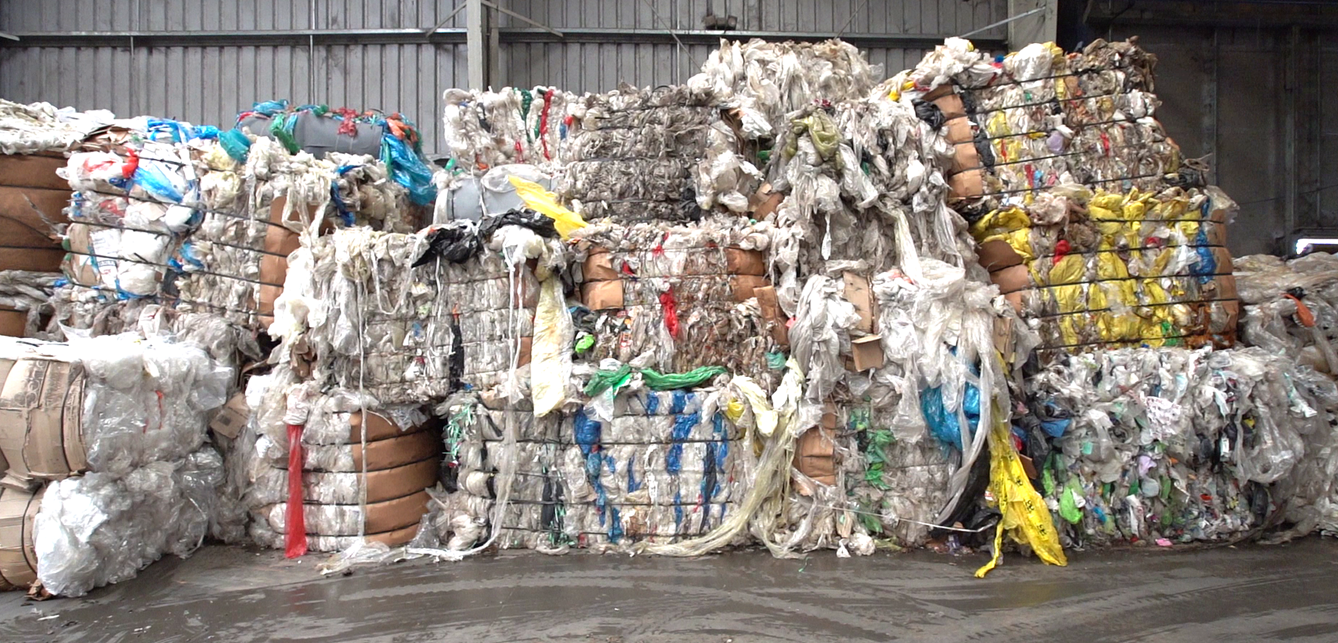
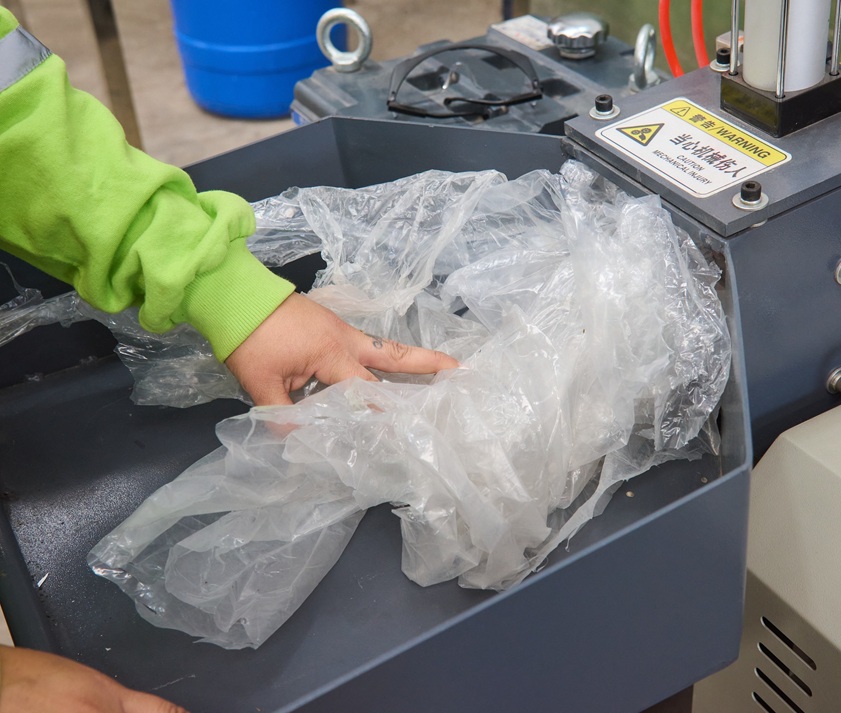 An increasing number of EPR laws are requiring high recycling rates for single-use plastics. Today, less than 5% of flexible plastics are recycled – and fewer than 30 North American reclaimers mechanically recycle polyethylene film, with less than half able to accept the lower-grade material that comes from households.
As EPR expands the supply of this material, the hardest problem to solve is generating the demand for these plastics from brands and manufacturers.
To answer that, Delterra and Eunomia developed a framework to evaluate more than 40 potential end-use applications for recycled household flexible plastics – screening each against four criteria to find the outlets most ready to absorb this material at scale.
⇒ Download the Report
We developed to evaluate potential end-use cases
- Additionality from past trials – Is post-residential recycled content already used for this product in North America, and would a successful trial demonstrate genuinely new technical findings?
- Technical feasibility for reclaimers – How much would a reclaimer need to change its processes and recipes to produce suitable recycled resin?
- Technical feasibility for converters – How much would a converter need to adapt its processes and product specifications to use this material?
- Potential to absorb household flexible PCR – How much of this material could the end market realistically take up by 2032?
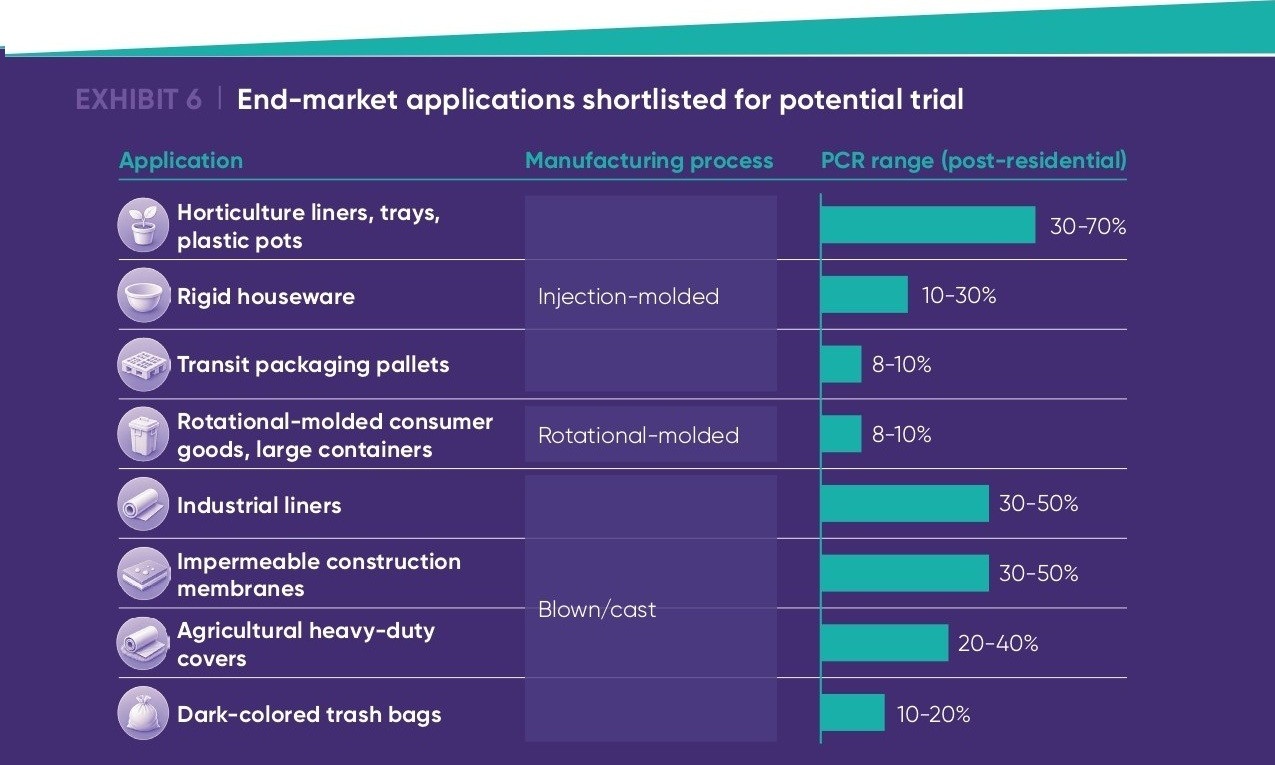
Applied across the full list, eight applications emerged as the most promising – a mix of injection-molded rigids and thicker-gauge mixed-color films that share a common profile: not food-contact-sensitive, tolerant of color variation and imperfections, and forgiving of variable resin composition.
The opportunity
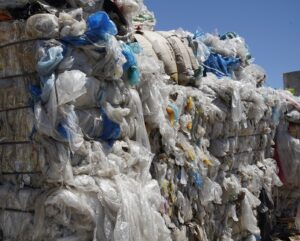 Together, these eight applications could absorb an estimated ~800K tons of recycled household PE film per year. Just three of them – industrial liners, impermeable construction membranes, and dark-colored trash bags – account for roughly 600K tons per year, or about 75% of the total.
The largest opportunity, in other words, lies in film applications, even though these are also the harder technical challenge.
The framework produces a shortlist of specific, testable end uses – a concrete starting point for the trials, partnerships, and real-world testing needed to make these markets real.
From insight to action
Identifying these applications is only the beginning. Now is the time for manufacturers to test how recycled household flexible plastics perform in real products – assessing technical performance, product quality, and the economics of using recycled content in place of virgin resin. Delterra and Eunomia developed the Recycled Flexibles Demand Accelerator, funded by Amcor and Kraft Heinz, to support exactly this work.
To learn more about the Recycled Flexibles Demand Accelerator, including joining the consortium, reach out to Jeremy Douglas.